

How Is Strep Throat Spread?
If you or your child suddenly develops a painful sore throat, fever, or difficulty swallowing, it can be worrying; especially when you are unsure whether the illness could affect other family members. Knowing what to watch for and when to seek medical care can help you respond quickly.
Strep throat is a bacterial infection that can cause significant throat discomfort and other symptoms. If symptoms are severe, rapidly worsening, or you need medical attention outside regular office hours, urgent care can provide timely evaluation.
What Is Strep Throat?
Strep throat is a bacterial infection of the throat and tonsils caused by Streptococcus pyogenes, also called group A Streptococcus (GAS). It commonly causes a sudden sore throat, fever, painful swallowing, swollen lymph nodes, and red or swollen tonsils.
Study: A systematic review and meta-analysis found that S. pyogenes was associated with about 63% of sore-throat cases in children and 92% in adults when a positive throat swab was present, highlighting the importance of appropriate testing.
Dangerous Strep Throat Symptoms
- Difficulty breathing: Trouble getting enough air or increasingly difficult breathing may signal a serious airway problem.
- Inability to swallow: Being unable to swallow liquids or saliva can cause dehydration and may indicate significant swelling.
- Drooling: Excessive drooling, especially in a child unable to swallow normally, requires prompt medical evaluation.
- Severe throat or neck swelling: Rapidly increasing swelling can interfere with swallowing or breathing.
- Severe one-sided throat pain: Intense pain on one side with swelling may indicate a peritonsillar abscess.
- Muffled or unusual voice: A sudden muffled voice can occur with significant throat swelling or an abscess.
- Neck stiffness or severe neck pain: These symptoms may occur with deeper infections and require urgent assessment.
- Confusion or extreme weakness: New confusion, fainting, or profound weakness may signal a serious infection or other emergency.
How Does Strep Throat Spread?
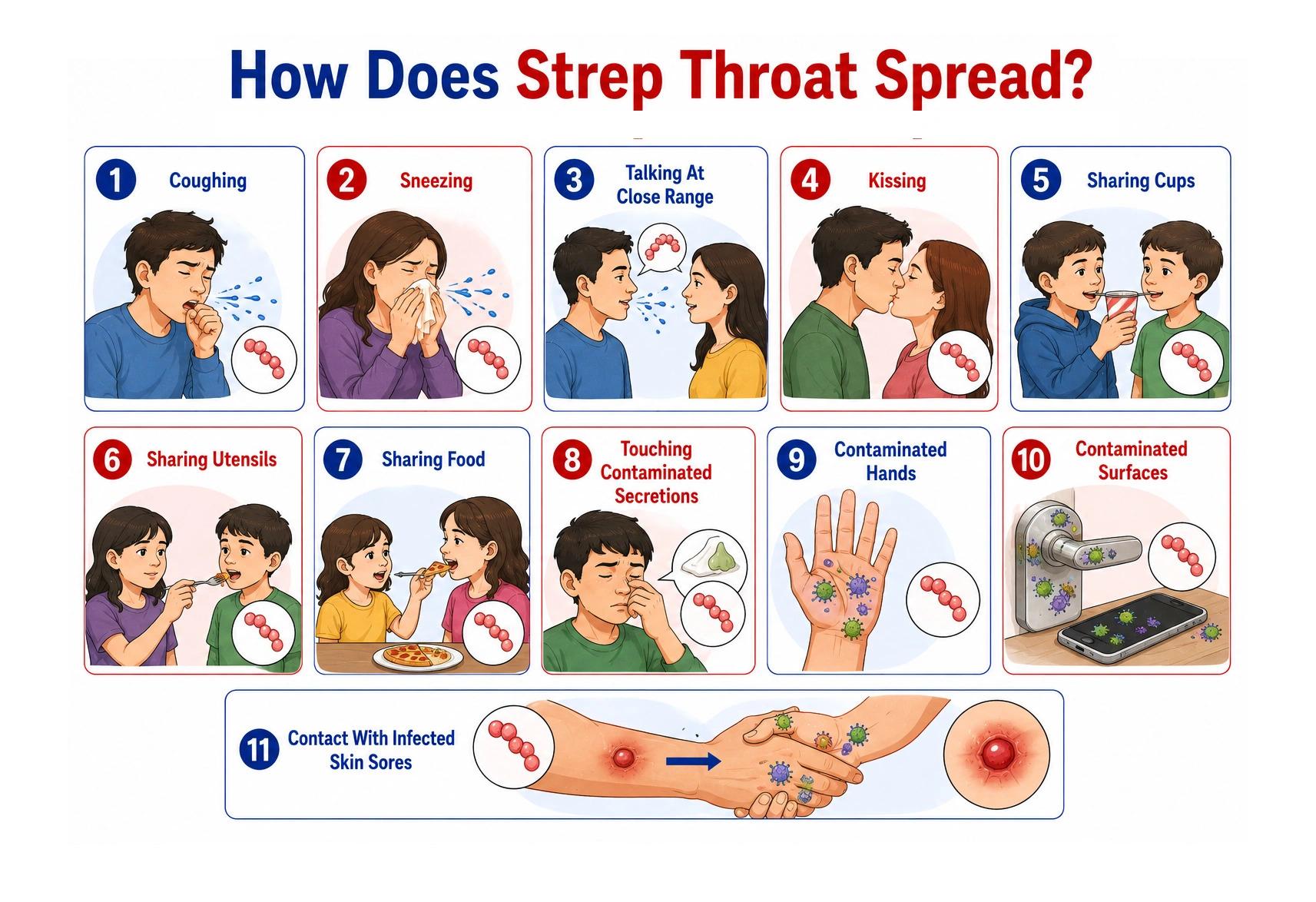
Strep throat is contagious, and the bacteria can move from an infected person's respiratory secretions or saliva to another person. The risk is higher among people who spend considerable time together, particularly in households, schools, daycare centers, and other crowded environments. Symptoms generally develop about 2 to 5 days after exposure, so someone may become sick several days after contact with an infected person.
Coughing
When someone with a group A strep infection coughs, respiratory droplets containing bacteria can enter the surrounding environment. A person nearby may become infected after inhaling these droplets or getting them into their mouth or nose.
Sneezing
Sneezing can release respiratory droplets containing group A strep bacteria. Being very close to someone who is infected during a sneeze increases the opportunity for those droplets to reach another person's nose or mouth.
Talking at Close Range
Talking can release respiratory droplets, particularly during prolonged close contact. Spending extended periods face-to-face with someone who has untreated strep throat can therefore increase exposure to the bacteria.
Kissing
Kissing can provide direct exposure to saliva and respiratory secretions, creating an opportunity for group A strep bacteria to pass between people. Avoiding kissing while someone is sick can reduce unnecessary exposure.
Sharing Cups
Sharing a cup or drinking container with an infected person can expose another person to saliva containing group A strep bacteria. Cups should be washed thoroughly before another person uses them.
Sharing Utensils
Forks, spoons, and other utensils can become contaminated with saliva. Sharing these items with someone who has strep throat can create an opportunity for the bacteria to reach another person's mouth.
Sharing Food
Taking bites from the same food or sharing food directly can transfer saliva between people. It is safer to avoid sharing food with someone who has a suspected or confirmed group A strep infection.
Touching Contaminated Secretions
Group A strep bacteria can be present in respiratory secretions and saliva. Touching contaminated material and then touching the mouth or nose can provide another opportunity for the bacteria to enter the body.
Contaminated Hands
Hands can pick up respiratory secretions or saliva from contaminated objects and surfaces. Touching the mouth or nose afterward can increase the chance of transferring bacteria, which is why regular handwashing is important.
Contaminated Surfaces
Group A strep can potentially spread through contaminated surfaces, although environmental transmission is considered less common than direct person-to-person respiratory or secretion exposure. Cleaning frequently touched objects can still help reduce exposure.
Contact With Infected Skin Sores
Group A strep can also cause skin infections, and bacteria may spread through contact with infected sores or drainage. This is a recognized route for group A strep transmission, although it is not the typical route responsible for ordinary strep throat.
Can You Get Strep Throat From Someone Who Doesn't Have Symptoms?
Yes, it is possible to be exposed to group A strep from someone who has no symptoms. Some people can carry the bacteria in their throat without appearing sick, although carriers are generally less likely to spread the bacteria than people with active strep throat. CDC notes that people who are carriers are also very unlikely to develop complications from the bacteria.
How Long Is Strep Throat Contagious?
Strep throat can remain contagious while the bacteria are present and untreated, which is why confirmed infections should be evaluated and treated appropriately. Antibiotics not only help shorten symptoms but also reduce the likelihood of passing group A strep to close contacts. The timing of returning to school, work, or daycare depends on fever status and how long effective antibiotic treatment has been taken.
- Before antibiotic treatment: A person with untreated strep throat can spread the bacteria to others, particularly during close contact.
- During the first 12 hours of antibiotics: Transmission risk is decreasing, but the person should generally continue avoiding school, work, or daycare until the recommended period of effective treatment has passed.
- After 12–24 hours of appropriate antibiotics: People are generally much less likely to spread the infection. CDC recommends staying home until fever-free and at least 12–24 hours after starting appropriate antibiotic treatment.
- If fever continues: Even after starting antibiotics, someone who still has a fever should remain home and follow their healthcare provider's advice about returning to normal activities.
- If symptoms are not improving: Contact a healthcare professional if symptoms are not improving after 48 hours of antibiotics, as further evaluation may be needed.
How to Prevent Strep Throat From Spreading
Preventing strep throat from spreading starts with reducing exposure to respiratory secretions and saliva and getting confirmed infections treated promptly. Good hygiene is especially important when someone in your household has a sore throat, fever, or a confirmed group A strep infection.
- Wash your hands frequently with soap and water.
- Cover your mouth and nose when coughing or sneezing.
- Avoid sharing cups, utensils, food, or drinks with someone who is sick.
- Avoid close face-to-face contact with someone who has untreated strep throat.
- Wash cups, plates, and utensils after a sick person uses them.
- Avoid kissing someone with an active strep infection until they are no longer considered contagious.
- Stay home from school, work, or daycare until fever-free and at least 12–24 hours after starting appropriate antibiotics.
- Take antibiotics exactly as prescribed if a healthcare professional confirms strep throat.
- Do not take leftover antibiotics or antibiotics prescribed for someone else.
- Clean frequently touched surfaces when someone in the household is sick.
- Seek medical evaluation if symptoms strongly suggest strep throat rather than assuming every sore throat is viral.
When to Go to the ER
Most cases of strep throat can be evaluated in an outpatient or urgent care setting, but certain warning signs require emergency attention because they may indicate a serious complication or airway problem. Peritonsillar and retropharyngeal abscesses are among the complications that can occur when infection spreads into nearby tissues.
- Trouble breathing or noisy breathing requires immediate emergency evaluation.
- Inability to swallow liquids or saliva can indicate significant throat swelling.
- Rapidly worsening throat or neck swelling can threaten the airway.
- Severe one-sided throat pain, drooling, muffled voice, or difficulty opening the mouth may indicate an abscess.
- Severe dehydration, very little urination, weakness, or dizziness requires prompt medical care.
- Fainting or confusion is not typical of uncomplicated strep throat and needs emergency assessment.
- Rapidly worsening symptoms should not be ignored or treated at home.
If you are worried about your symptoms or your child is becoming increasingly uncomfortable, it is understandable to want prompt care rather than waiting and wondering. Our 24/7 emergency room is available to evaluate urgent symptoms, with an ER wait time under 12 minutes to help you get assessed as quickly as possible.
Strep Throat Care at Memorial Springs ER
When strep throat causes severe difficulty swallowing, trouble breathing, significant throat or neck swelling, dehydration, or rapidly worsening symptoms, Memorial Springs ER in Spring, Texas, is available 24/7 for emergency evaluation and care. Our emergency team can assess severe symptoms, perform appropriate diagnostic testing, and provide treatment based on your condition. If your strep throat symptoms become severe or you are concerned about a serious complication, do not wait for them to worsen. Visit Memorial Springs ER for prompt emergency medical attention.
Key Takeaways
- Strep throat is a bacterial infection caused by group A Streptococcus.
- It can spread through respiratory droplets and contact with saliva or respiratory secretions.
- Untreated strep throat can remain contagious and may lead to complications.
- Antibiotics can reduce contagiousness and help prevent certain complications when strep throat is confirmed.
- Seek emergency care for trouble breathing, inability to swallow saliva, severe swelling, or rapidly worsening symptoms.
Frequently Asked Questions
How Long Does Strep Throat Last?
Strep throat symptoms usually improve within a few days after starting appropriate antibiotics, while untreated infection may last longer. Antibiotics can shorten symptoms and reduce the risk of complications and transmission.
What Causes Strep Throat?
Strep throat is caused by group A Streptococcus (Streptococcus pyogenes), a contagious bacterium that infects the throat and tonsils. Close contact with an infected person is the most common risk factor.